

Returning to the Roots: Beijing Hyundai Enters the Post-Million-Vehicle Era of Breakthrough
Summary: Over the past two to three years, China’s automotive market has undergone a dramatic transformation. The success or failure of companies’ strategic moves will determine their future standing in the Chinese car market. No brand can afford to rest on its laurels. Volkswagen’s market dominance has been severely tarnished by a sudden scandal, while Audi and BMW—once leaders in the luxury-car segment—are now facing fierce competition from other automakers... All these brands that once enjoyed strong market positions are now grappling with challenges; how much more so for other brands?
Over the past two to three years, China’s automotive market has undergone a dramatic transformation. The success or failure of companies’ strategic moves will determine the major shift in their future positions within the Chinese car market. No brand can afford to rest on its laurels. Volkswagen’s market dominance has been severely tarnished by a sudden scandal, while Audi and BMW—once leaders in the luxury car segment—are now facing fierce competition from other automakers... Even these brands that once enjoyed strong market advantages are now grappling with difficulties; how much more so for other brands?
As an automaker that has consistently exceeded annual production and sales of one million vehicles for three consecutive years, Beijing Hyundai has entered the “post-million-vehicle” era. Yet, like other automakers, it too faces significant challenges. In an increasingly fierce competitive environment, how to achieve a breakthrough beyond the one-million-vehicle mark has become a major challenge for Beijing Hyundai. Through its product and technology strategy unveiled at the Beijing Auto Show, Beijing Hyundai’s approach to the post-million-vehicle phase is already beginning to take shape. Having emerged stronger from the challenges of 2015, Beijing Hyundai is now setting out anew with a “starting from zero” mindset—and in 2016 alone, it launched five new models, marking the start of a new chapter in the company’s strategic roadmap.
Piece 1: Embrace the first launch and strengthen the layout of segmented products.
In recent years, as China’s auto market has experienced a rapid downturn and competition among automakers has become increasingly volatile, relying on just one or two best-selling models is no longer sufficient to sustain a company’s market performance. As a mainstream manufacturer of family sedans, Beijing Hyundai boasts highly competitive products in several niche segments. However, to achieve the milestone of exceeding one million units sold, the company will need a more refined, more segmented, and more strategically aligned product lineup.
Over the past two years, Beijing Hyundai has taken impressive steps in terms of product structure, the number of new models introduced, and market segmentation. In particular, in the rapidly growing SUV market, the joint venture has assembled the most comprehensive lineup of four models among its peers. However, in the C-class car segment—where it has traditionally held a strong position—performance in 2015 actually lagged behind.
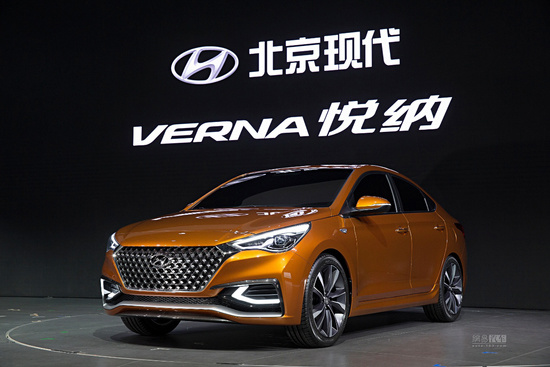
Although the growth rate of the sedan market has been slowing down continuously, it remains the largest segment in terms of vehicle stock—and a market that companies simply cannot afford to overlook if they want to achieve growth. This year, Beijing Hyundai is shifting its focus back to the sedan market. Following the launch of the new-generation midsize sedan, Lingdong, at the end of March, Beijing Hyundai made another high-profile debut at the Beijing Auto Show with the introduction of the compact car, Verna. As a new member of the Verna family, the Verna boasts an updated design and enhanced powertrain performance, better catering to the needs of younger consumers. Once it hits the market, the Verna will join the previous Verna model, the Reina, forming a dual-model lineup that further solidifies Beijing Hyundai’s position as the No. 1 player in the compact car segment.
The launch of the Verna also highlights Beijing Hyundai’s efforts to streamline its multiple product lines and shift toward a more refined product-layout strategy. By reorganizing its three sedan brands, the company has created a seamlessly integrated product portfolio that caters to consumers’ diverse needs across various vehicle segments. The Sonata brand emphasizes a high-quality positioning, with the Mistra, Sonata, and Sonata Hybrid leading the mid-to-high-end car market; the Elantra brand, featuring the Lingdong and Avante, leverages superior product performance and cost-effectiveness to target the midsize car segment; and the Verna brand, together with the Verna and the Ray, focuses on the premium compact car market, meeting young consumers’ car-buying demands through outstanding design and product capabilities. Together with its four SUV models, these three sedan brands will lay a solid foundation for achieving sales volumes exceeding one million units.
Piece No. 2: The So9 Hybrid Movement Makes Its Debut, Further Enhancing Technical Strength
As everyone knows, Beijing Hyundai’s products have long left consumers with a deep impression: “excellent value for money.” However, automakers are constantly upgrading their technologies and powertrains, and consumers’ expectations regarding technology and driving quality are steadily rising. In the post-million-vehicle era, whether the company can achieve new breakthroughs in technology and product features will become the cornerstone for supporting its products and brand.
In previous interviews with Xu Heyi, Chairman of BAIC Group, and senior executives from Beijing Hyundai, both emphasized Hyundai Motor’s remarkable progress in technological innovation. This progress is attributable to Hyundai’s relentless efforts and meticulous refinement of new product technologies and driving performance—efforts that have been particularly focused on its global expansion, especially its ambition to gain a stronger foothold in the European market.
In fact, Beijing Hyundai has already begun to benefit from Hyundai Motor’s technological advancements. With recently launched models such as the ninth-generation Sonata, the all-new Tucson, and the Lingdong, one can clearly sense Beijing Hyundai’s “European-style” orientation in terms of product features.
At this Beijing Auto Show, Beijing Hyundai’s ninth-generation Sonata hybrid model further highlighted the company’s technological prowess and strategic positioning in the new-energy vehicle sector. The vehicle is equipped with the TMED system—a system that ranks among the most advanced hybrid systems in the industry. It’s not only the world’s first model to feature a GDi engine in its hybrid system, but it also utilizes lithium batteries that are technologically more advanced than those found in competing models. The 2.0 GDi engine delivers a power output of 115 kW and 189 N·m, enabling it to drive the vehicle either independently or in tandem with the electric motor. Moreover, the electric motor can not only start and stop the engine and provide propulsion for the vehicle, but also recover braking energy, significantly enhancing the vehicle’s range. Thanks to its parallel architecture, the powertrain of the ninth-generation Sonata hybrid can seamlessly switch between the engine and the electric motor, striking an optimal balance between fuel efficiency and performance.
In the new-energy vehicle sector, Hyundai boasts an extensive technological portfolio. At the Beijing Auto Show, Hyundai officially launched IONIQ—a brand exclusively dedicated to new-energy vehicles. In addition to HEVs, this new-energy brand will also encompass PHEVs and EVs, among other advanced new-energy technologies. Backed by Hyundai’s robust technological expertise, Beijing Hyundai plans to further localize production of more new-energy vehicle models in the future. Following the official launch of the Sonata Hybrid this year, the company is expected to introduce all-electric and plug-in hybrid new-energy vehicles in 2017 and 2018.
Beijing Hyundai’s plan is to have new-energy vehicle sales account for 10% of its total sales within the next five years. Breakthroughs in new-energy technologies and technologies such as small-displacement turbocharging will serve as one of the key driving forces behind Beijing Hyundai’s achievement of surpassing one million vehicles sold.
Piece Three: Cangzhou Factory Sees New Breakthrough in Production Capacity as It Begins Operations in the Fourth Quarter
As is well known, Beijing Hyundai is a rapidly growing company. For the past several years, it has been hampered by insufficient production capacity—its planned capacity stands at only 1.05 million vehicles, leaving it with little room for maneuver. To move forward to the next stage of reaching a production volume of one million vehicles, it must build up a reasonable and ample capacity reserve.
Outside Beijing, the Cangzhou plant—invested in by Beijing Hyundai—will begin production in the fourth quarter of this year. The Verna, which made its debut at the Beijing Auto Show, will soon be manufactured at the Cangzhou plant. By then, Beijing Hyundai’s total production capacity will increase to 1.35 million vehicles. Meanwhile, the Chongqing plant in the western region will start operations next year. In the future, Beijing Hyundai’s five plants will address the company’s long-term capacity bottlenecks, creating a north-south production layout with a combined capacity of 1.65 million vehicles. This strategic expansion is the fundamental guarantee for Beijing Hyundai to surpass the one-million-vehicle mark and will help the company enhance its ability to navigate the national automotive market, tap into the potential of third- and fourth-tier cities, and gain greater flexibility in responding to challenges in the automotive industry.
Piece Four: Elevating Overall System Strength in the 8-Million-User Era
Beijing Hyundai has maintained a production volume of one million vehicles for three consecutive years, and to sustain this scale of one million units or higher, it must rely on lean management and robust systemic capabilities to support its efforts in expanding its market presence, enhancing its brand image, developing precise and effective products, improving marketing efficiency, optimizing dealer management, and advancing its new-energy vehicle strategy.
By the second half of this year, Beijing Hyundai’s cumulative number of users will surpass 8 million. How to enhance the experience and reputation of existing users and fully tap into their potential for repeat purchases will pose a new challenge for Beijing Hyundai’s customer service system. On the other hand, in response to the rising purchasing power in fourth- and fifth-tier cities and the trend toward younger consumers, Beijing Hyundai is also exploring new channel management and marketing communication strategies. In terms of costs, it is reported that Beijing Hyundai will soon join Hyundai Motor’s global procurement platform, leveraging its channel advantages to strengthen cost control and further reinforce Beijing Hyundai’s original competitive edge in terms of value for money.
During the launch of Lingdong, Liu Zhifeng, Executive Deputy General Manager of Beijing Hyundai, analyzed in a media interview that the Chinese automotive market is no longer at a stage where competitors vie solely on their strengths; rather, it’s now a competition of overall systemic capabilities—focusing on who has no significant weaknesses. Having emerged from the difficulties of 2015, Beijing Hyundai has taken further steps to prepare and enhance its capabilities across all areas, including branding, product development, marketing, and production.
Piece Five: Layout Marketing—Conveying the Brand Essence of “Innovative Technological Vitality”
While making comprehensive efforts in product development and technological advancement to continuously enhance our product capabilities, Beijing Hyundai’s post-one-million-vehicle era also has one particularly important goal: achieving a breakthrough in the company’s brand strength. To effectively convey Beijing Hyundai’s evolution in product capabilities and technological innovation to more consumers and establish a brand-new corporate image, we need not only superior product strength but also precise brand marketing strategies.
On the one hand, in response to the rise of the mobile internet and the increasingly younger demographic of mainstream consumers, Beijing Hyundai has accelerated the pace of integrating its products, sales channels, and services with the internet. By widely adopting smart technologies—such as intelligent in-vehicle connectivity systems—in its models, the company is maximizing its ability to accommodate users’ mobile interaction habits. Through multi-channel sales platforms, it is catering to changing consumer preferences. And via online maintenance platforms and the BlueMembers customer service system, it is offering users an internet-based approach to service delivery.
On the other hand, as innovation takes center stage, dynamic elements are being infused into Beijing Hyundai’s brand essence, and Beijing Hyundai’s innovative marketing efforts will continue to gain momentum. At the Beijing Auto Show, whether it was the return of celebrity Hu Renzhi, who once again sparked intense interest in the new Verna, or the incorporation of elements such as the European Cup and rally racing, all conveyed the brand’s vibrant energy. This year, in addition to sponsoring international events like the European Cup and marathons, Beijing Hyundai will also partner with activities such as the Colorful Run, fully embracing a youthful and energetic brand image.
Stay true to our original aspiration and return to our roots. As we enter the post-million-vehicle era, Beijing Hyundai has already embarked on a meticulously planned strategic deployment across product development, technology, production capacity, and overall systemic strength. At the same time, the new brand ethos—“innovation, technology, and vitality”—is continuously being infused into the company’s very DNA. These are precisely the vital keys that will enable this million-vehicle-scale automaker to achieve its second leap forward. Standing atop the million-vehicle milestone, Beijing Hyundai is fully prepared.
Relevant updates

Whether at night or during the day, and no matter where it’s used, Proton’s continuously innovative lighting systems provide you with peace of mind and safety.
Copyright © 2025 Danyang Bao Teng Automotive Components Co., Ltd.
Powered by: www.300.cn Tag
Contact Us
Address: Xin Qiao Group Building Industrial Park, Danbei Town, Danyang City, Jiangsu Province